Aesthetic medicine is evolving rapidly in India. From clinical cosmetology and lasers to botulinum toxin, dermal fillers, threads and regenerative procedures, doctors today have access to a wide range of aesthetic treatments.
But with so many courses and institutes available, one question comes up repeatedly:
How do you choose the right aesthetic medicine course?
The answer isn’t simply about the course fee, certificate or duration. A good aesthetic medicine program should help you develop clinical understanding, practical confidence, patient-handling skills and the ability to build ethical aesthetic practice.
Here are the key factors doctors should consider before enrolling.
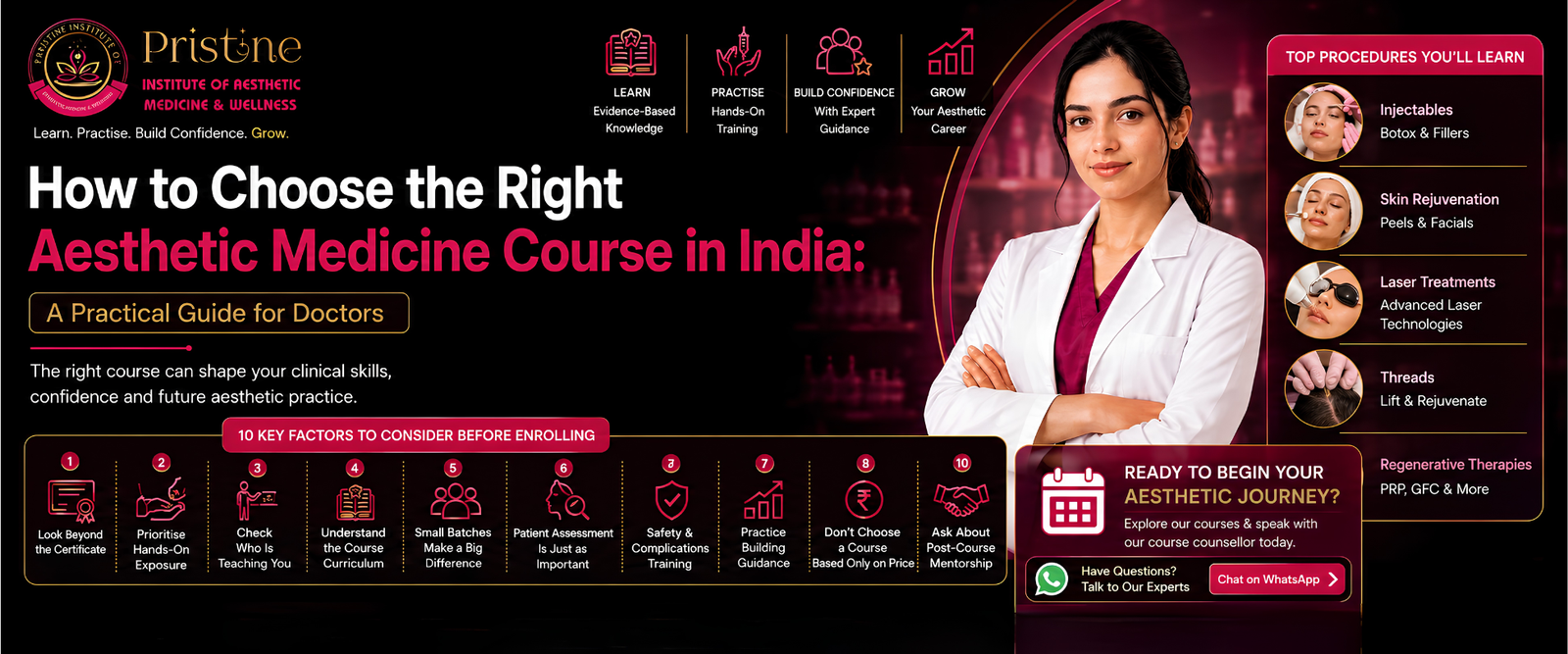
- Look Beyond the Certificate
A certificate may prove that you completed a course. It does not necessarily prove that you are confident performing a procedure.
Before choosing a course, ask:
- How much practical training is included?
- Will I observe or actually perform procedures?
- Will there be supervised hands-on training?
- How many cases will I get exposure to?
- Will complications and patient selection be discussed?
The real value of an aesthetic medicine course lies in the quality of clinical learning, not simply the certificate you receive at the end.
- Prioritise Hands-On Clinical Exposure
Aesthetic medicine is highly practical.
Understanding the theory behind botulinum toxin, fillers, threads, lasers or regenerative procedures is important, but clinical confidence develops through patient assessment and supervised practice.
A good hands-on program should expose you to the complete clinical process:
Consultation → Assessment → Treatment Planning → Procedure → Aftercare → Follow-up
Learning this complete pathway is far more valuable than simply watching demonstrations.
- Check Who Is Teaching You
Faculty experience matters.
Look for trainers who are actively involved in aesthetic practice and can teach not only how to perform a procedure but also:
- When to perform it
- When not to perform it
- How to select patients
- How to manage expectations
- How to recognise complications
- How to plan follow-up
- How to communicate risks and limitations
A good mentor should teach you the clinical reasoning behind the procedure, not just the technique.
- Understand the Course Curriculum
Aesthetic medicine is a broad field. A course should have a clearly defined curriculum rather than simply listing popular procedures.
Depending on your career goals, you may want exposure to areas such as:
Clinical Cosmetology
Skin assessment, common dermatological concerns, chemical peels, medi-facials and skin rejuvenation.
Trichology
Hair and scalp assessment, hair-loss management and commonly used regenerative approaches.
Lasers and Energy-Based Devices
Understanding indications, patient selection, parameters, contraindications and safety.
Facial Aesthetics
Botulinum toxin, dermal fillers and facial assessment.
Threads
Patient selection, treatment planning, technique and complication awareness.
Regenerative Aesthetics
Procedures and technologies used for skin and hair rejuvenation.
The right curriculum depends on whether you are looking for a foundation in clinical cosmetology or advanced training in aesthetic medicine.
- Small Batches Can Make a Big Difference
When practical training is involved, batch size matters.
In a very large group, students may spend most of their time watching others perform procedures.
Smaller batches can allow greater interaction with faculty and more opportunities to discuss individual cases.
Before enrolling, ask:
“How many students will be training in my batch, and how much individual hands-on exposure can I expect?”
This simple question can tell you a lot about the quality of practical training.
- Patient Assessment Is Just as Important as Procedure Technique
One of the biggest mistakes beginners can make is focusing only on technique.
Aesthetic medicine begins before the procedure.
You need to learn how to evaluate:
- Facial anatomy and proportions
- Skin condition
- Hair and scalp concerns
- Patient expectations
- Medical history
- Contraindications
- Previous procedures
- Appropriate treatment options
Sometimes the best aesthetic decision is not to perform a procedure.
A responsible aesthetic practitioner understands this.
- Look for Training That Covers Complications and Safety
Every medical procedure has potential risks.
A good aesthetic medicine course should therefore discuss:
- Contraindications
- Infection prevention
- Emergency preparedness
- Common adverse effects
- Recognition of complications
- Appropriate first-line management
- When to refer a patient
This is particularly important for doctors entering the field of injectables.
Confidence should always be accompanied by caution and clinical responsibility.
- Does the Institute Teach You How to Build a Practice?
Learning procedures is only one part of becoming an aesthetic practitioner.
Many doctors eventually want to establish or expand their own aesthetic practice.
In that situation, additional guidance can be extremely valuable:
- Clinic setup
- Equipment planning
- Treatment menu development
- Pricing strategy
- Patient consultation
- Photography and documentation
- Patient retention
- Ethical marketing
- Social media presence
- Basic business planning
A course that combines clinical training with practice-building guidance can provide a more complete learning experience.
- Don’t Choose a Course Based Only on Price
Course fees can vary considerably.
But the cheapest course isn’t necessarily the best value, and the most expensive course isn’t automatically the best.
Instead, compare:
Fees + Duration + Faculty + Batch Size + Hands-On Exposure + Curriculum + Mentorship + Support
Then ask yourself:
“What will I actually be able to do confidently after completing this course?”
That is a much better way to evaluate the investment.
- Ask About Post-Course Mentorship
A common concern among doctors after completing aesthetic training is:
“What happens when I encounter my first difficult case?”
This is where mentorship becomes valuable.
A strong educational institute should ideally provide some form of continued academic support, case discussion or mentorship after the course.
Because learning doesn’t necessarily end on the final day of training.
Choosing the Right Course for Your Career Stage
There isn’t one perfect aesthetic medicine course for everyone.
If you are new to clinical cosmetology
A comprehensive foundation program covering skin, hair, lasers, cosmetology procedures and patient assessment may be more appropriate.
If you already have aesthetic experience
An advanced fellowship focusing on injectables, threads and regenerative procedures may be more suitable.
If you want to specialise
Short, focused programs in areas such as chemical peels, hydrafacial, microneedling, PRP, PMU or laser procedures can help you develop specific skills.
The important thing is to choose a course that matches your existing knowledge and your long-term clinical goals.
Why Hands-On Training Matters
At Pristine Institute of Aesthetic Medicine & Wellness, Pune, our approach is centred around combining academic learning with practical clinical exposure.
Our programs are designed to help students understand not only the theory behind aesthetic procedures but also the complete clinical journey — from consultation and patient assessment to treatment planning, supervised hands-on experience and follow-up.
Our training pathways include programs in clinical cosmetology, advanced aesthetic medicine, permanent makeup and nutrition, along with focused certificate programs.
For doctors interested in advanced aesthetic medicine, our Fellowship in Advanced Aesthetic Medicine (FAAM) focuses on practical training in areas including injectables, threads and regenerative aesthetics.
Our philosophy is simple:
Learn the science. Understand the patient. Practise under supervision. Build confidence responsibly.
Final Checklist Before You Enrol
Before paying for any aesthetic medicine course, ask these questions:
- Who will teach me?
- What exactly is included in the curriculum?
- How much hands-on training will I receive?
- Will I work with real patients under supervision?
- How many students are in the batch?
- Are complications and patient safety covered?
- Is there post-course mentorship?
- Does the course match my current level?
- Does the institute provide guidance beyond procedures?
- What skills should I realistically expect to gain after completing the course?
If an institute can answer these questions clearly, you are already in a much better position to make an informed decision.
Ready to Begin Your Aesthetic Medicine Journey?
Choosing the right institute is an important investment in your clinical education.
At Pristine Institute of Aesthetic Medicine & Wellness, Pune, we aim to provide structured education, practical clinical exposure and ongoing mentorship to doctors and aesthetic professionals who want to develop their skills responsibly.
Explore our courses, speak with our course counsellor, and choose the program that fits your career goals.
Pristine Institute of Aesthetic Medicine & Wellness
Pune, Maharashtra
Learn. Practise. Build Confidence. Grow.